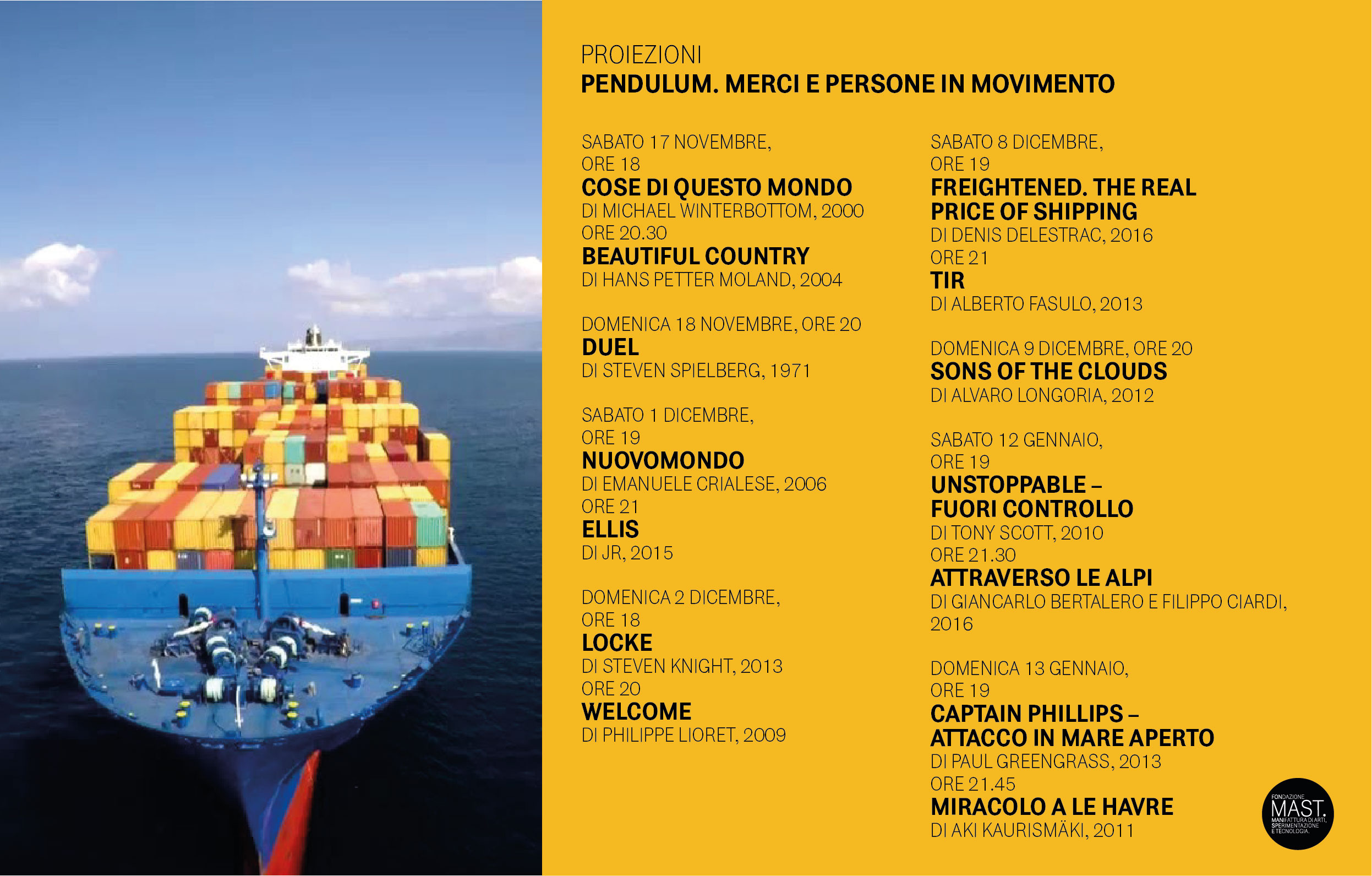
For the exhibition Pendulum. Moving goods, Moving people, the MAST Foundation presents a series of movies on the themes of global mobility, transport, and migrations.
Series organised in collaboration with Cineteca di Bologna
SATURDAY 1 DECEMBER
7 PM
MAST.AUDITORIUM
NUOVOMONDO (GOLDEN DOOR)
directed by Emanuele Crialese, 2006, Italy, 114 min.
In a desolate corner of the Sicilian countryside lives a family of farmers who have worked the land for generations, inextricably bound to nature and to the mysterious spirits of the dead which have always accompanied the living in those areas. Their never-changing everyday life is interrupted by news from the New World describing it as a land of astonishing abundance. Salvatore decides to sell everything—home, land, and animals—to bring his children and his elderly mother to a place where work and bread aren’t as scarce. But to become citizens of the New World, they have to die and be born again. The four must abandon their archaic habits and superstitions, striving to toughen both body and mind, learning to obey and to pledge their loyalty to a new authority, and surrendering to modernity. They’ll have to do it in the suspended time of the ocean crossing: four long weeks that separate them from their final judgement at Ellis Island, that wondrous, terrible place where families are forced to decide, and are often separated forever. Not all of them are destined to cross through the gates of Paradise.
ELLIS
directed by JR, 2015, USA, 14 min.
Ellis, starring Roberto De Niro and written by Erich Roth, is a work that shakes up our collective memory, bringing us back to the early years of Ellis Island, the gate of entry to the New World. The documentary is set in the abandoned sanatorium on the island facing New York, and through the touching art installation Unframed by the French photographer JR, it recalls the story of the immigrants who literally made America what it is. The men, women, and children who fled from poverty, discrimination, and dictatorships in search of a new life in the early decades of the twentieth century foreshadow the destiny of those who, in a globalised world, now seek the same opportunities for safety and dignity in America and Europe.
SUNDAY 2 DECEMBER
6 PM
MAST.AUDITORIUM
LOCKE
directed by Steven Knight, 2013, USA-GB, 85’
Ivan Locke drives through the night towards London. He works in building construction, but tonight there’s going to be the most important demolition of his life. At dawn he should oversee the largest concrete pour of his career thus far. His boss has assigned the task to him because his record over the last nine years has been flawless: he’s the best, the most reliable construction foreman, solid as concrete. But a phone call from a woman named Bethan rewrites Locke’s life, setting in motion a series of events with potentially catastrophic effects for his family, his work, and his soul. A fast-paced cinematographic experience in which the timing of the events coincides with the timing of the narration, this film literally captures us, catapulting us into a car seat next to the protagonist and setting before us the themes of fairness, of assuming one’s responsibility, no matter how uncomfortable and punitive it may be, and of the extreme fragility of the moral constructs on which we build our existence and our certainties.
SUNDAY 2 DECEMBER
8 PM
MAST.AUDITORIUM
WELCOME
directed by Philippe Lioret, 2009, France, 110 min.
Simon is a swimming instructor in a city-run pool in Calais on the north coast of France. His marriage is on the rocks, and he does his job on autopilot until he meets Bilal, a young, undocumented Kurd who has has crossed Europe to reach England and the woman he loves. After a failed attempt to cross the border, the only way Bilal can realise his dream is by swimming across the Channel, and Simon is the only one who can help him train: the young man’s bravery and his determination to keep his love at all costs convinces Simon to put himself personally on the line, defying the law to help him in what seems to be an impossible endeavour.
SATURDAY 8 DECEMBER
7 PM
MAST.AUDITORIUM
FREIGHTENED: THE REAL PRICE OF SHIPPING
directed by Denis Delestrac, 2016, USA, 84 min.
Ninety percent of goods we consume in the West are manufactured in faraway lands and brought to us by ship. The maritime shipping industry is a key player in the world economy, and it forms the basis of our model of modern civilisation; without it, it would be impossible to fulfil the ever-growing demands of our societies. Yet the functioning and rules of this industry remain unknown to most, while its hidden costs affect the lives of us all. Due to their size, freight ships can no longer berth at city harbours; they have moved far away from the eyes of public opinion, behind gates and barriers. But who pulls the strings in this billion-dollar business? To what extent does this industry influence national politics? How does it impact the environment? Taking us on a journey through the oceans, the film offers a courageous investigation into international maritime shipping and sheds light on the consequences of an all but invisible industry.
SATURDAY 8 DECEMBER
9 PM
MAST.AUDITORIUM
TIR
directed by Alberto Fasulo, 2013, Italy/Croatia/Bulgaria, 89 min.
Branko, a native of Croatia, works as a lorry driver for an Italian transport company. He once was a teacher, but his new job earns him three times his old salary. He drives all over Europe, alone or with his co-driver Maki, a thirty-year-old with a young son waiting for him at home, a man increasingly uncertain about whether to continue in this line of work. Branko’s phone calls with his wife or son are the only contact he has with his family. The result of five years of field research, Tir shows life on the road for its protagonist, the professional actor Branko Zavrsan, who actually did earn the driving license required by the highway code. Between roads, motorways, junctions, and warehouses for loading goods, a route is plotted along non-places, all identical yet separated by a geographical distance that hides the weight of the hard work under which Branko seems to test his own resistance.
SUNDAY 9 DECEMBER
8 PM
MAST.AUDITORIUM
SONS OF THE CLOUDS
directed by Alvaro Longoria, 2012, Spain, 110 min.
This film examines the current political crisis in North Africa, emphasising the responsibility of Western powers, in particular the United States and France, which apply foreign policies based on aggressive economic strategies to the detriment of basic ethical principles. These policies have generated tremendous instability, resulting in chaos and repeated episodes of violence, such as the attacks made by the Moroccan police on the Sahrawi, who were encamped in the desert in November of 2010 in a peaceful protest for human rights. The focus of the narration is the Western Sahara, which according to the UN is the only African territory still subject to colonialism and worsening conditions and rights in recent years.
SATURDAY 12 JANUARY
7 PM
MAST.AUDITORIUM
UNSTOPPABLE
directed by Tony Scott, 2010, USA, 99 min.
One October day at dawn, in a major railway station in Pennsylvania, a careless worker has to move a very long, stopped train onto another track and engages the automatic controls. The train starts to move and immediately picks up speed with no one on board. Since most of its load is toxic waste and chemical products, the consequences of it derailing could be devastating. If the toxins were to leak, they would be capable of decimating an entire city. Three hundred kilometres later, the veteran engineer Frank Barnes and the young, newly hired conductor Will Gordon have just begun their shifts. What they don’t yet know is that a chaotic, frenetic day awaits them that is destined to turn them into heroes.
SATURDAY 12 JANUARY
9:30 PM
MAST.AUDITORIUM
ATTRAVERSO LE ALPI (ACROSS THE ALPS)
directed by Giancarlo Bertalero and Filippo Ciardi, 2016, Italy, 81 min.
To whom do the Alps belong? Who regulates their “life”, the people who live there, and the goods and passengers who travel through them? What and how many products are shipped each day on lorries and trains through tunnels and Alpine passes, and how does this transport affect the everyday life of the citizens throughout Europe? How does it affect the natural environment? Through the emblematic stories of railway workers, lorry drivers, motorists, environmental tourists, and other travellers, this film seeks to highlight the importance of these questions and find answers while journeying through the mountains of Italy, France, Austria, Switzerland, Germany, and Slovenia to discover the complexities of transporting people and goods, along with some of the key players in these movements that flow like rushing streams, constantly threatening to flood.
SUNDAY 13 JANUARY
7 PM
MAST.AUDITORIUM
CAPTAIN PHILLIPS
directed by Paul Greengrass, 2013, USA, 134 min.
A high-tension thriller and at the same a detailed portrait of the myriad side effects of globalisation, this film recounts the 2009 hijacking of the US cargo ship Maersk Alabama by a band of Somali pirates. Inspired by a true story, the events primarily rotate around the figure of the Alabama’s commander, Captain Richard Phillips, and his Somali counterpart, Muse, who takes him hostage. The face-to-face conflict between the two begins when Muse and his crew aim for Phillips’ unarmed ship, but in the course of the events the two men find themselves at the mercy of forces completely beyond their control. The film is much more than the tale of how a cargo ship was hijacked by pirates and the breathtaking odyssey of an accidental hero: the news story told by the media throughout the world becomes a reflection on geopolitics that have exploded and gone haywire, in which the rupture of September 11th continues to form cracks, wounds, and divisions, and where the global presence of the United States collides with diametrically opposed local realities.
SUNDAY 13 JANUARY
9:45 PM
MAST.AUDITORIUM
LE HAVRE
directed by Aki Kaurismäki, 2011, Finland/France/Germany, 93 min.
Marcel Marx, a bohemian and former author, chooses to withdraw to the port city of Le Havre, where his honourable but unprofitable profession as a shoeshiner gives him the feeling of being closer to the people. He keeps his literary ambition alive and leads a simple, quiet life arranged around the corner pub, his work, and his wife, Arletty, when suddenly destiny catapults a young immigrant boy from sub-Saharan Africa into his life. The heart of the film lies entirely in the relationship between the befuddled shoeshiner and the young migrant. The man, who in the meantime has discovered that his wife is ill, takes care of the boy and tries to help him get to England, creating a network among his neighbours and seeking to escape the notice of a disenchanted policeman.