VISIONES
The value of work in the cinematography of Spanish culture
The film program is organized in collaboration with Exit Media and Hispania Asociaciòn Cultural.
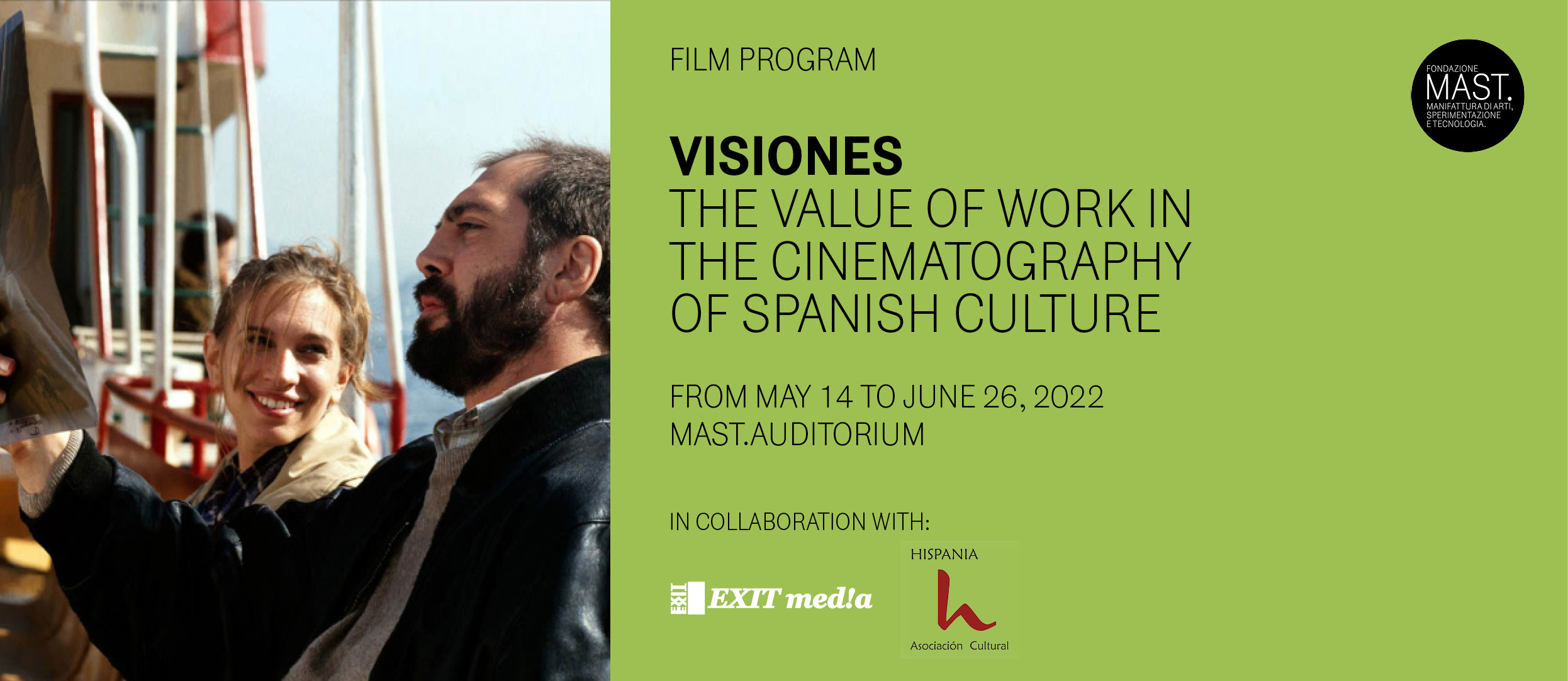
From 14 May to 26 June 2022, the Fondazione MAST presents a wide-ranging film program created in collaboration with Exit Media and Hispania Asociaciòn Cultural entitled: VISIONES. The value of work in the cinematography of Spanish culture.
The film program is an exploration of cinema and of the culture of work in Spanish-speaking countries: a series of 16 films including feature films, documentaries and experimental films that illustrate, through comedy and drama, the world of work.
In particular, not to be missed some films lend insight into the transition that took place in cinema during the Franco regime, such as Cuadecuc-Vampir by director Pere Portabella, whose two short films commissioned to commemorate the Catalan artist Joan Mirò are also on the calendar, and O Todos o ninguno by Helena Lumbreras, who was the collaborator of Pasolini and who introduced militant cinema to Spain. The film program will also screen the small masterpiece Los lunes al sol by Fernando León de Aranoa, for which the talented Javier Bardem received the Goya Award for Best Leading Actor, as well as winning the first prize as Best Film.
The playbill presents other important titles, almost all of which enjoyed limited distribution in Italy and are very rare to see on the big screen. Meetings are also scheduled with som film directors, who will speak in the Auditorium to present their works.
For Latin American cinema, Mexican director Lila Avilés, making her feature film debut with La camarista, draws a picture of a working woman in a luxury hotel in Mexico City who is subject to the whims and extravagant behavior of customers: a film dedicated to all the waitresses of the world. Argentinean Hernán Guerschuny in El Crítico tells the story of a stereotypical film critic with lightness, intelligence and a sense of irony. His film has received a warm welcome at various festivals in Latin America.
Natalia Marín Sancho will present the film series
In an industrial warehouse, 11 people are hired to do their jobs in front of an audience they can’t see. There is a construction worker, a butcher, a seamstress, a waiter, a mechanic, a computer scientist, a cleaning lady… Artwork, reality show, or macabre experiment? The participants do not know what they are facing, nor whose hands are pulling the strings behind this perverse little theater, a biting parable about job insecurity that is of utmost relevance.
Thanks to its dry narrative, which is direct and devoid of false moralism, La mano invisible induces the viewer to reflect on the dark direction in which humanity is rapidly slipping, a downward trajectory towards the vain hunt for dignity through work: a chilling system of productivity in which dignity plays no part.
In 1953, Luis García Berlanga and Juan Antonio Bardem, two of the greatest directors in the history of Spanish cinema, made their debut with the feature film Esa pareja feliz, united in the fight against censorship and driven by the desire to rummage through the wretchedness of Franco’s Spain.
The film tells the story of Juan and Carmen, a humble couple from Madrid. She is a housewife and he works as an electrician at a film production studio. Their dream of wealth becomes a reality when they win a famous competition sponsored by a soap brand. And so they are chosen as “the happy couple”: during 24 hours they will be guests at all kinds of events and will receive numerous complimentary gifts. But, just that same day, Juan finds himself having to solve two serious problems that Carmen knows nothing about.
In collaborazione con:

Shy and reserved Eve works as a waitress in a luxury hotel in Mexico City. The requests of wealthy guests, often bizarre and pretentious, only underline the socioeconomic gap between the accommodation’s servants and clients. The film serves as a parable of the entire nation, which is divided more than ever between those who are increasingly better off and those who can only aspire to climbing one step on the social ladder.
A Mexican candidate for the 2020 Oscar for Best International Film, Lila Avilés has put her long theatrical experience to good use, stemming from a piece already brought to the stage by the actress and director. The film’s origins also lie in the book L’Hôtel by artist Sophie Calle, the result of her experience as a waitress in a hotel in Venice. Like a spy, Calle had photographed all the items, trash, and clothes that guests left in their rooms, getting a sense of their behavior and personality through their things.
A famous film critic with sophisticated tastes (the nouvelle vague and Godard above everyone and everything) randomly meets a girl and falls in love with her at first sight: he thus experiences first-hand a love story, or a romantic comedy, that is everything he has always disparaged as abhorrent in his reviews.
A directorial debut that successfully challenges the job of film critic through a meta-filmic game teeming with references. It features two stars of Argentine cinema: the famous playwright Rafael Spregelburd (El hombre de al lado, 2009) and Dolores Fonzi. The film won the Critics Award at the Gramado Festival in Brazil in 2014.
Cuadecuc-Vampir is very likely the film key to understanding the transition in Spanish cinema from the period of the nuevos cines (meaning movie theaters, which had been authorized by the Franco government) towards clandestine activities, illegal or clearly in opposition to the regime itself.
The film was shot in 1970 during the shooting of Jess Franco’s commercial film El Conde Drácula. In the film, Portabella violently disrupts the standard narrative in two ways: he totally eliminates color and replaces the soundtrack with a landscape of image-sound collisions, with the collaboration of the pianist Carles Santos.
Provocatively filmed, in 16mm and with sound negatives, the tension between black and white fosters the strange “ghostly materialism” of this film. Vampir-Cuadecuc is a revealing analysis of the mechanisms behind constructing the illusionism of the dominant narrative cinema and constituted a radical disruption in the Spanish film institution.
Spain, a northern city facing the problems of the industrial crisis. Santa, José, Lino, Reina, Amador, Serguei: friends who, after losing their jobs at the shipyards, pass their days between drinks at the bar, philosophy discussions, and improbable searches for new occupations, between the melancholy of a difficult future and the momentary joys that crop up unexpectedly. Quick to remember the only precious commodity that remains for them: dignity.
Inundated by a flow of Goya Awards (the Spanish Oscars), the film is an enjoyable comedy that makes use of skillful writing and, above all, the masterful work of all its actors, especially Javier Bardem.
Positioning itself between the Loach of Raining Stones and Riff raff and Kaurismaki, León de Aranoa creates a small masterpiece: he inspires emotion without being upsetting, inspires thought without being arrogant and sometimes even finds time to make us have fun.
The Spanish branch of an American multinational is obligated to enforce the smoking ban inside the offices. From now on, those who want to smoke during working hours must do so in the street. Ramírez, one of the employees, decides to collect signatures against that which he considers unjust and out of line. What Ramirez wants is for an unoccupied office room to be used as a smoking room, as the Americans say. It would appear that everyone agrees and will support it. However, in the tête-a-tête with each of his colleagues, Ramírez has to face a series of evasions and excuses for not being part of the list. This first film by the Guall-Wallovitz duo, winner of the Goya Award for Best Debut of 2002, offers a glimpse into ambitions, petty intrigues, revenge and envy in a corporate microcosm.
A popular emblematic district of Barcelona is the object of an urban reform plan, thus initiating the construction of a new condominium. En construcción is a documentary that, alongside the construction of a building, portrays people, professions, relationships, a neighborhood, a district, and an era. It is Barcelona and, at the same time, it is many districts of many European cities: the layers of time, the precarious balance between the inhabitants and their stories, the transformations and the desire to renew themselves constitute together the genesis of an inexorable change.
According to its director, José Luis Guerín: “We wanted to get to know the intimacy of a construction site, and so we went there when that space was still a square where the children played football. On this ground we sought a way of coexisting, of getting acquainted and of filming – these things, in this order – that would allow us to face both the everyday life of our construction site and what was generated around it: in that daily routine broken by the noise of the demolition, among the neighbors, in the neighborhood. Indeed, the image of the neighborhood materialized in the handful of faces that, in our eyes, represented it. In this process, we soon realized that the mutation of the urban landscape also involved a mutation of the human landscape.”
Salvador was considered the best salesmen in the company, but a lot of water has passed under the bridge and the determination from his early days is now only a vague memory. The protagonist’s very life is in chaos, and young colleagues are increasingly fierce. His last big opportunity is the upcoming trade fair and his boss has clearly warned him: if he is not able to sell two hundred plasma televisions in two days, he is out of the company. Salvador initially suffers this blow, feeling betrayed after having given the company the best years of his professional life, but then decides that he does not want to give up. During the fair, Salva meets Inés, a beautiful and dynamic hostess who is ready to help him in his mission.
A puerta fría is a tragicomedy about work and human relations in which it almost feels like not only the appliances have price-tags attached, but also the people who sell them.
The film was comissioned by the Galeria Maeght to commemorate Joan Miró’s exhibit organized by the French Ministry of Cultural Affairs at the Grand Palais in Paris that opened on May 17, 1974. It took five days to shoot the film and it shows the smelting and casting process of the work known as Puertas Mallorquinas by Joan Miró. The filming team travelled to the foundry owned by the Parellada family in Llinars de Munt. The bronze sculptures weigh 1.200, 800 and 650 kilos respectively and were cast in one piece in a kiln specially constructed for the occasion.
Miró tapís
(Miró tapestry)
by Pere Portabella, Spain, 1976, 24 min
— DOCUMENTARY
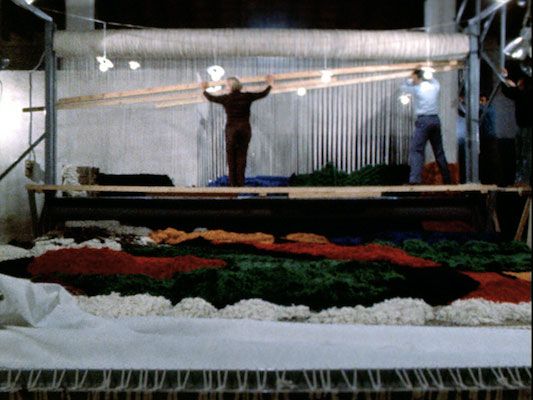
The film was commissioned by the Galeria Maeght for Joan Miró’s exhibit organized by the French Ministry of Cultural Affairs in the Grand Palais in Paris that opened on May 17, 1974. The film was shot in six days in Montroig del Camp (Miró’s country home) and in Tarragona throughout the process of elaboration that lasted eight months of an original tapestry in which 1.200 kilos of wool were used and 600 kilos for the warp. The tapestry was 6 meters wide and 11 meters long and weighed a total of 3.500 kilos. A special loom had to be built to weave it. The day the Twin Towers of the World Trade Center in New York were attacked, September 11, 2001, the tapestry was hanging in the hall of one of the towers and was destroyed along with it.
O todos o ninguno
(Everyone or Nobody)
by Helena Lumbreras, Colectivo Cine de Clase, Spain, 1976, 41 min
— DOCUMENTARY
The workers’ struggles intensify in Spain after Franco’s death in 1975. In the industrial suburbs of Barcelona, the workers of the FORSA steel company declare a strike, take control of the means of production and decide to fight for their conditions and rights. Two young directors, Helena Lumbreras and Mariano Lisa, belonging to the Cine de Clase Collective, actively participated in the strike, one of the most symbolic in the recent history of Spain. In a meeting with the other “comrades”, they decided on how to film the occupation. Helena Lumbreras, a former student of the Experimental Center of Rome, was a leading figure in the panorama of European militant cinema. She was the first to insert cinema into factories in Spain, considering it an urgent need, a political weapon, and a tool in the service of the class struggle. Pasolini’s collaborator, Lumbreras was imbued with his epic-religious vision of the world, and with O todos o ninguno she created a filmic utopia of political and revolutionary vocation.
In collaboration with:
Set in the rural Spain of Francoism, Los santos innocentes tells of the intense and heartbreaking relationship – a sort of consensual slavery – between the owners of an estate in Extremadura and the family of farmers at their service: farmers whose destiny is marked by their origin and social condition, and by a future without hopes or dreams. Mario Camus’ film was successful at the Cannes Film Festival, with the two main actors, Alfredo Landa and Paco Rabal, winning the ex aequo award. The story of Paco’s family, el Bajo, is still moving: a tale of a rural, patrimonial and savage Spain, which unfortunately was not so long ago.
While the streets of Madrid are invaded by no-global protesters, seven candidates participate in a selection for an executive position in a multinational. Palpable tension and a competitive atmosphere fills the space among the participants. Feelings of distrust increase when candidates find out they are all there for the same reason and that the Grönholm Method will be used to evaluate them, a strategy adopted in the United States to evaluate human resources, where they decide for themselves who deserves that position. Unaware they are being observed, they will find themselves embroiled in a psychological challenge that will be carried out up to the very last minute. Taken from the play The Grönholm Method by Jordi Galceran, the film won the Goya Prize (the Spanish Oscars) for the best non original screenplay.
In 1977, the owners of the household appliance company Numax S.A., two Germans who had previously supported the Nazi regime and who had lived in Barcelona since the 1950s, decide to close the factory. A group of workers resumes production in a self-managed way and after two years of struggle, with the 600,000 pesetas (about 3,600 euros) in the resistance fund, they ask the filmmaker JoaquIm Jordà to make a collective film that recounts the experience.
The story of the Numax factory resistance, one of the most iconic of Spanish militant cinema, is that of a workers’ movement that, following the death of the dictator Franco, aspired to a transformation of the political and social system. Numax presenta… became a witness of the transition towards a democracy that betrayed the working class’s aspirations for social change.
After the screenings, a taste of Spanish cuisine will be offered to close the festival.
Director Xavi Puebla presents the last screening of Visiones film program
The pharmaceutical multinational Farewell-Gutmann has lost Ruiz, the esteemed general manager. Thus begins the scramble for succession to the once-in-a-lifetime position for Lazarus, Adela and Fernando, interrupted by the arrival of the eccentric manager, Lüger, who comes from the headquarters to choose the new foreman and bring order.
The protagonists of Xavi Puebla’s second work try to hide their poverty, but the only thing they achieve is revealing the pathos of their ambitions. Condemned to live professionally within the same four walls, they will end up discovering that “hell is other people.”
Bienvenido a Farewell-Gutmann is a poetic fable about ambition and about the moral damage caused by the vehement pursuit of professional and social success. A drama about the diseases of the soul and the neuroses of contemporary society, the film expresses deeper evils, such as family failure, professional degradation and pathological aggression.
After the screenings, a taste of Spanish cuisine will be offered to close the festival.