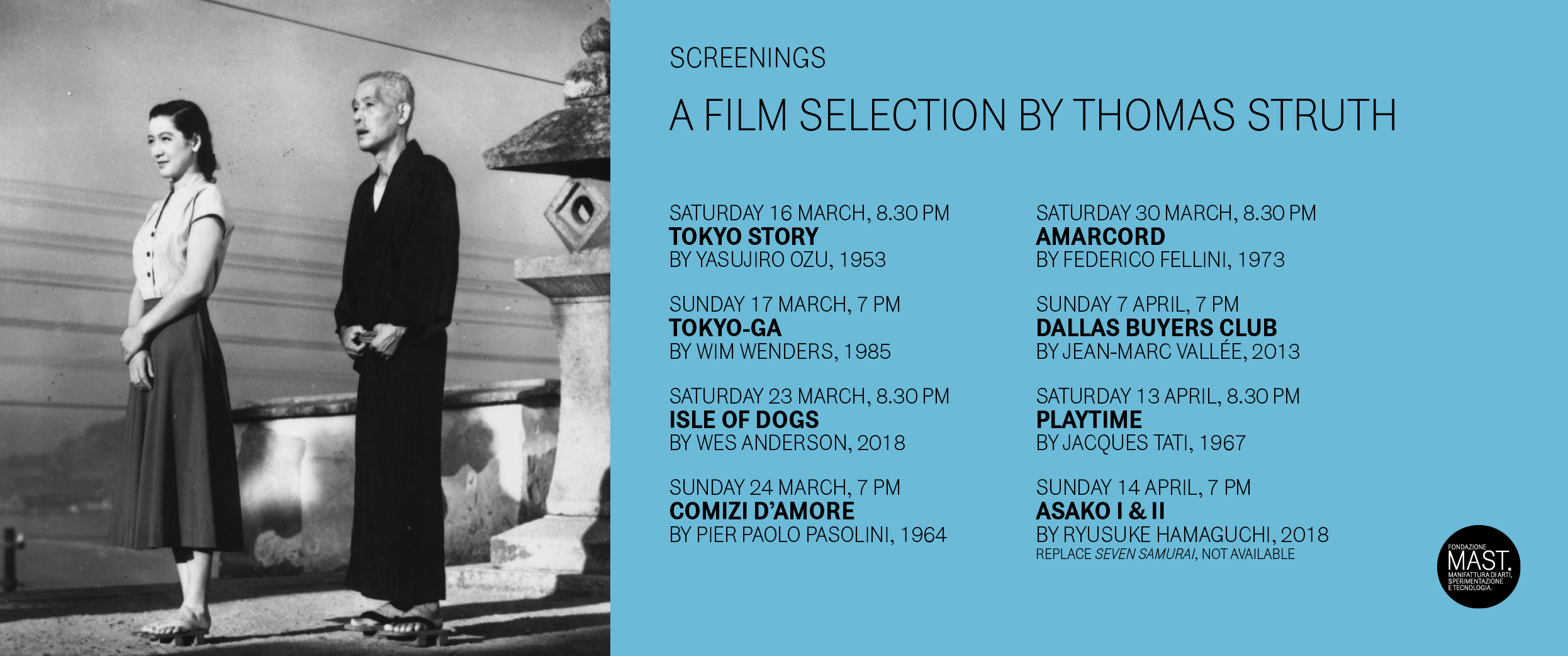
The MAST Foundation has invited Thomas Struth, the protagonist of the exhibition currently on view in the PhotoGallery, to share with the public the films that have marked his intellectual and artistic education and contributed to his visual research – works he considers relevant also for the younger generations. The artist has selected eight films which add new meaning to MAST’s public programme, now offering visitors the original, unpredictable perspective of one of the greatest names in contemporary photography. Originating from different historical and geographical contexts, Struth’s selection, just like his work, addresses topics such as social structures, the physical world, the unconscious, mortality, and reflects on some of the questions raised by the artist, particularly the relationship between nature and politics and the idea of technological development as a sole promise of human progress.
In these films we will find echoes, resonances and connections also with the aesthetics of Struth’s œuvre – from Unconscious Places, a series of streets depicted with the documentary accuracy of the Düsseldorf School, to Family Portraits, photographs of contemporary, urban tribes confined in their homes, from the thick jungle of the Paradise series to the mysterious technological sanctuaries of Nature & Politics displayed at MAST.
The screenings are organized in collaboration with Cineteca di Bologna
SATURDAY 16 MARCH 2019
8.30 PM
MAST.AUDITORIUM
TOKYO STORY
by Yasujiro Ozu, Japan, 1953, 136’
Shukichi and Tomi, now close to seventy, decide to make a long trip to Tokyo to visit their children before it is too late. Once they arrive in the capital, the reception is not what they expected: the eldest son Koichi, a doctor, and his sister Shige, a hairdresser, are too busy with their jobs to be bothered with their elderly parents, who they seem to regard as more of a nuisance than a joy. Only Noriko, widow of the second son Shoji who died eight years before, shows sincere affection for the former in-laws, although there is no blood tie between them.
Ozu’s most cherished themes – the instability of the Japanese family following the war, the lack of communication between generations, the negative influence of urban life on human relationships are recounted with a painful modesty, an extreme lucidity and a language of purified simplicity that make it a masterpiece in the history of cinema.
o.v. in Japanese with Italian subtitles
SUNDAY 17 MARCH 2019
7 PM
MAST.AUDITORIUM
TOKYO-GA
by Wim Wenders, Germany, 1985, 92’
The director Wim Wenders arrives in Tokyo for a journey through memory in search of everything that might be remembered about Yasujiro Ozu, the great master of Japanese cinema, who died destitute and almost forgotten in 1963, and, at the same time, frame today’s metropolitan reality with his own lens. Through interviews with Chisu Ryu, the main actor in Ozu’s films, and Yuharu Atsuta, the very loyal director of photography, Wenders alternates daring shots and disoriented sequences of life in Tokyo today. The filmmaker does not merely record a city on film, but renders it as a place of the soul where, with the premise of establishing a parallel with Ozu’s settings, he discovers a new world, in full economic boom and at the same time studded with moments pervaded by tradition. Savouring words, he accompanies us slowly through the neon and blossoming cherry trees, transforming us into veritable traveling companions.
o.v. in English, Japanese and German with Italian subtitles
SATURDAY 23 MARCH
8.30 PM
MAST.AUDITORIUM
ISLE OF DOGS
by Wes Anderson, USA, 2018, 101’
In 2037, an unbridled increase in the dog population and the spread of a mysterious “canine flu” force the mayor of the city of Megasaki, in the Japanese archipelago, to adopt a drastic emergency measure: to quarantine all the dogs in the country, segregating them on an island used as a waste and garbage dump. Following the disappearance of his guard dog Spots, a twelve-year-old named Atari Kobayashi heroically hijacks a small airplane and pilots it to the Island of dogs. After the brusque landing, he is helped by a few mongrels, willing to do anything to escape the depressing condition they find themselves in. Touched by the boy’s courage and devotion towards his lost pet, Chief, Rex, Boss, Duke and King vow to protect him from the men who are chasing him and escort him on the dangerous journey that will decide the fate of the entire Prefecture. o.v. in o.v. in English with Italian subtitles
SUNDAY 24 MARCH
7 PM
MAST.AUDITORIUM
COMIZI D’AMORE
by Pier Paolo Pasolini, Italy, 1964, 90’
Introduction by Marco Antonio Bazzocchi
Halfway between a sociological documentary and cinéma vérité, Love Meetings (Comizi d’amore), Pasolini’s fifth feature, is an interesting survey of love and sex in Italy in the 1960s. Directed by Pasolini and with his own commentary, there are also conversations with Alberto Moravia and Cesare Musatti, as well as contributions from Camilla Cederna, Oriana Fallaci and Giuseppe Ungaretti. The numerous interviews conducted throughout every part of Italy with men, women and children are divided into four blocks. In Research 1, a great Italian-style mixed fry-up, Pasolini, ironically self-described as “a sort of traveling salesman”, asks his compatriots how they welcome a film like this and their attitudes towards sex in real life; in Research 2, disgust or pity? the controversial topic of so-called sexual inversions and perversions is tackled instead; Research 3, the true Italy? investigates the different conceptions of sex in Italian regions; to conclude the film, in Research 4, from the bottom and from the depths, the director analyses the results of the survey, taking stock of it all with his friend Moravia.
o.v. in Italian
SATURDAY 30 MARCH
8.30 PM
MAST.AUDITORIUM
AMARCORD
by Federico Fellini, Italy, 1973, 123’
In the 1930s in Borgo, an imaginary village in Romagna, the teenager Titta is growing up and subject to conditioning inside and outside his home. His father Aurelio is a small building contractor who perennially disagrees with his wife; Uncle Patacca drifts along in the background of the other relatives; Uncle Teo is committed to an insane asylum; the grandfather selfishly enjoys excellent health, and does not hesitate to take liberties with the maid. In the town, some characters destined to become part of Titta’s adolescent memories stand out: Gradisca, a buxom hairdresser; Volpina, a slightly mad girl who lacks inhibitions; a mammoth, almost monstrous tobacconist; a lawyer with an easy and grandiloquent line of rhetoric; Gudizio, the village madman; Biscein, the liar; the exhibitionist motorcyclist and a whole gallery of characters who, through their actions in the worlds of school or church, at fascist parties, folkloristic rituals or special events, reveal their specific characteristics. The seasons pass inexorably, marked by the falling of snow or the “manine” (the fluff puffs) released by the first spring flowers. It’s time to grow up…
o.v. in Italian
SUNDAY 7 APRIL
7 PM
MAST.AUDITORIUM
DALLAS BUYERS CLUB
by Jean-Marc Vallée, USA, 2013, 117’
It’s the second half of the 1980s, and Ron Woodroof, a Texan electrician and rodeo cowboy addicted to alcohol, drugs and sex, suddenly receives the news that he is suffering from acquired immune deficiency syndrome and has only a few months to live. Frustrated by the lack of available treatment but far from resigned to the death sentence, Woodrof begins to study the illness. He finds comfort in alternative treatments that come from Mexico and are not approved by the Food and Drug Administration, going against the scientific community and specialized doctors, including his therapist. Although a stranger to the homosexual community, Ron allies himself with the young transsexual Rayon, who is also ill with AIDS but determined to survive. Together, Ron and Rayon start up a buyers’ club to sell contraband drugs to other HIV-positive sufferers who, by paying a monthly fee, can have access to supplies. Ron finds meaning in his illness and ultimately his own life in the struggle for the right to dignity, information and care for all those in the same condition. The film is based on actual events.
o.v. in English with Italian subtitles
SATURDAY 13 APRIL
8.30 PM
MAST.AUDITORIUM
PLAYTIME
by Jacques Tati, France, 1967, 108’
In a Paris that is light years from the traditional Ville Lumière, Monsieur Hulot, already protagonist of Mon Oncle and Monsieur Hulot’s Holiday, accompanies us through a series of places in the city where an aseptic modern style pervades and conditions every aspect of everyday life. The film is divided into six sequences that are connected by the presence of two characters who meet several times throughout the day: the Hulot himself and Barbara, a visiting American girl. In the futuristic Paris proposed by the film, characterised by vast multi-lane streets and imposing steel buildings with clean lines, modern cold glass and artificial furnishings, only irrepressible nonconformity, human nature’s imagination and a certain nostalgia for the good old days can give vital breath to an otherwise sterile and alienating urban lifestyle.
o.v. in English, French and German with Italian subtitles
SUNDAY 14 APRILE
7 PM
MAST.AUDITORIUM
ASAKO I & II
by Ryusuke Hamaguchi, Japan/France, 2018, 119’
Young Asako falls in love with Baku, handsome “bad boy” who one day suddenly disappears without notice. Two years later the girl moves from Osaka to Tokyo and meets Ryohei, a young man working for a sake company and looking exactly like Baku. Asako starts dating him because of this resemblance, but she soon becomes fond of his gentle, sweet nature, so different from her former boyfriend’s disposition. But one day Baku, now a successful model, reappears and forces the girl to make a decision. Who will she choose? The idealized, troubled love of her teenage years of the calmer, reassuring relationship she is currently into?
The film was in the official selection of Cannes Film Festival 2018.
o.v. in Japanese with Italian subtitles
The film replaces the screening of Akira Kurosawa’s Seven Samurai, which is not available.