

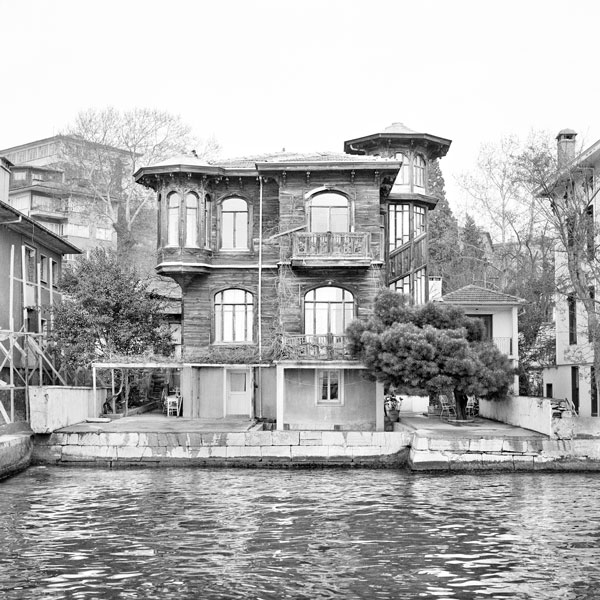
Ursula Schulz-Dornburg, Bosporus, 1978, ©Ursula Schulz-Dornburg
Some Homes by Ursula Schulz-Dornburg presents six series created between the 1960s and the early 2000s across Netherlands, Georgia, Russia, Turkey, Iraq and Indonesia, documenting homes built from natural materials meant to disappear within a few years, as well as installations designed to last centuries, combining a documentary style with conceptual influences and social concerns. Some of these structures result from deliberate architectural planning, others from millennia-old traditions rooted in specific environmental contexts, and yet others from spontaneous, childlike impulses. What unites them, however, is their ability to simultaneously respond to practical needs (shelter, rest, storage) and cultural purposes (self-representation, affirmation of belonging to a group, communication of social status), always within the limits imposed by the relationship with the resources and the environmental conditions.
Ursula Schulz-Dornburg (born 1938 in Berlin) grew up in the aftermath of the Second World War – an era defined by new borders in Europe and elsewhere. Since the 1970s, she has sought out places of transit and borderlands, locations geographically and politically caught up in a state of in-between. She studied journalism at the Institute für Bildjournalismus in Munich from 1959–1961. In 2016 she received the Aimia/AGO Photography Prize from the Art Gallery of Ontario and won the Catalogue of the Year award at the Paris Photo–Aperture Foundation PhotoBook Awards for The Land In Between in 2018. In 2025 Schulz-Dornburg has been awarded both the NRW Art Award and the Bernd and Hilla Becher Award. Schulz-Dornburg’s work features in the collections of K21, Düsseldorf, DE; the Museum für Fotografie, Berlin; The Art Institute of Chicago; Museum Kunstpalast, Düsseldorf; Tate Modern, London; J. Paul Getty Museum, Los Angeles; Pinakothek der Moderne, Munich; NY Public Library, New York; National Gallery of Canada, Ottawa; Bibliothèque nationale de France, Paris; National Gallery of Art, Washington D.C. The artist lives and works in Düsseldorf.
Location
Pinacoteca Nazionale di Bologna
Via delle Belle Arti, 56

The exhibition is accessible to people with reduced mobility.
OPENING HOURS
TUESDAY–SUNDAY, 10AM – 7PM
The Painting Gallery is located in the former Jesuit novitiate of Sant’Ignazio, built in the latter half of the seventeenth century and designed by Alfonso Torreggiani. The permanent collection features works from the thirteenth through the eighteenth century by a wide range of famous artists such as Raphael; Giotto; Ludovico, Annibale, and Agostino Carracci; Guido Reni; and Amico Aspertini, as well as other important collections.
GUARDA IL VIDEO DELLA MOSTRA DI URSULA SHULZ-DORNBURG