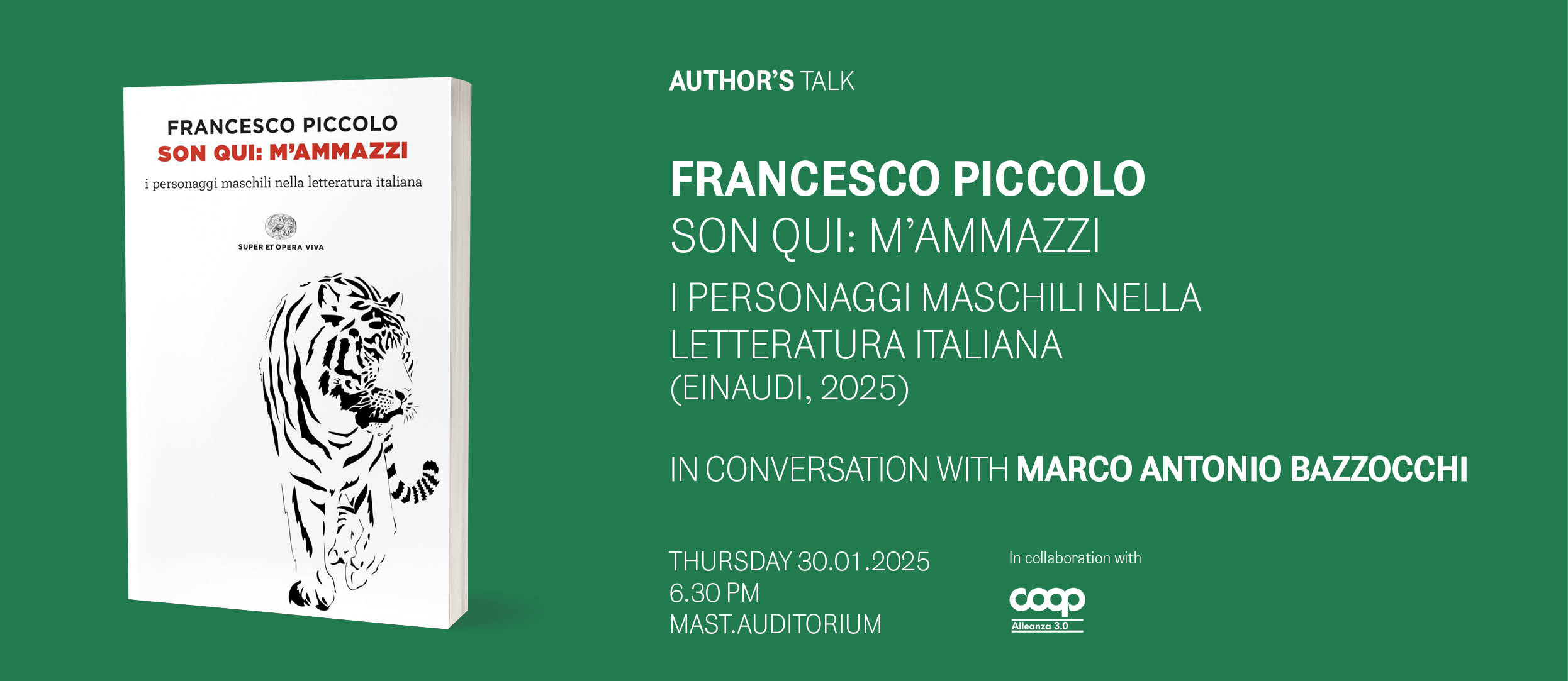
If the impression we have of men is that they are powerful, arrogant, violent, selfish and ravenous, then, of these men, there will be traces also in the key works of our literature, those that have in some way helped to consolidate a certain idea of the male. Beginning with Boccaccio’s Decameron with the young schoolboy Rinieri’s ruthless revenge against a comely widow who rejects him to the marital vicissitudes of Zeno that Svevo writes about. Zeno Cosini, arrogant and fragile at the same time, irrational who pretends to be thoughtful, but above all, like any self-respecting man, moth-eaten by desire, which once planted in the head no longer snaps off and makes people perform the most foolish and thoughtless gestures. And then again Manzoni’s Unnamed, Tomasi di Lampedusa’s Prince of Salina, Verga’s ‘Ntoni, Brancati’s Antonio, Fenoglio’s Milton, and other males, all the same as themselves, cowardly and furious, jealous and violent, at the center of novels that have built the canon of Italian literature. Because who we are has to do with family, upbringing, the world where one grows up, but also with the books one has read.
As part of the review Le Voci dei Libri, in collaboration with Coop Alleanza 3.0
FREE ADMISSION BY RESERVATION
Book nowFrancesco Piccolo is a writer and screenwriter. For Einaudi he published La separazione del maschio (2008), Momenti di trascurabile felicità (2010), Il desiderio di essere come tutti (Premio Strega 2014), Momenti di trascurabile infelicità (2015), L’animale che mi porto dentro (2018) and Momenti trascurabili (2023). In the Einaudi Tascabili, Storie di primogeniti e figli unici (2012), Allegro occidentale (2013), L’Italia spensierata (2014) and in Arcipelago Scrivere è un tic (2024) have been reissued. With La bella confusione (2023 and 2024), he won the “Viareggio-Rèpaci” Literary Prize non-fiction section 2023 and the “Giuseppe Tomasi di Lampedusa” International Literary Prize 2023.
Marco Antonio Bazzocchi, Full Professor of Contemporary Italian Literature and Literature of the Romantic Age. His main interests include literary hermeneutics dedicated to authors of the 1800s and 1900s, particularly Leopardi, Pascoli, Pasolini, and Campana. Areas of research include the representation of corporeality in the text as a vehicle for symbolic representations, the relationship between literature and anthropology, and the function of visuality in literary works. He has published essays on Pasolini, Leopardi, the transformation of Italy through modern literature.