8 PM
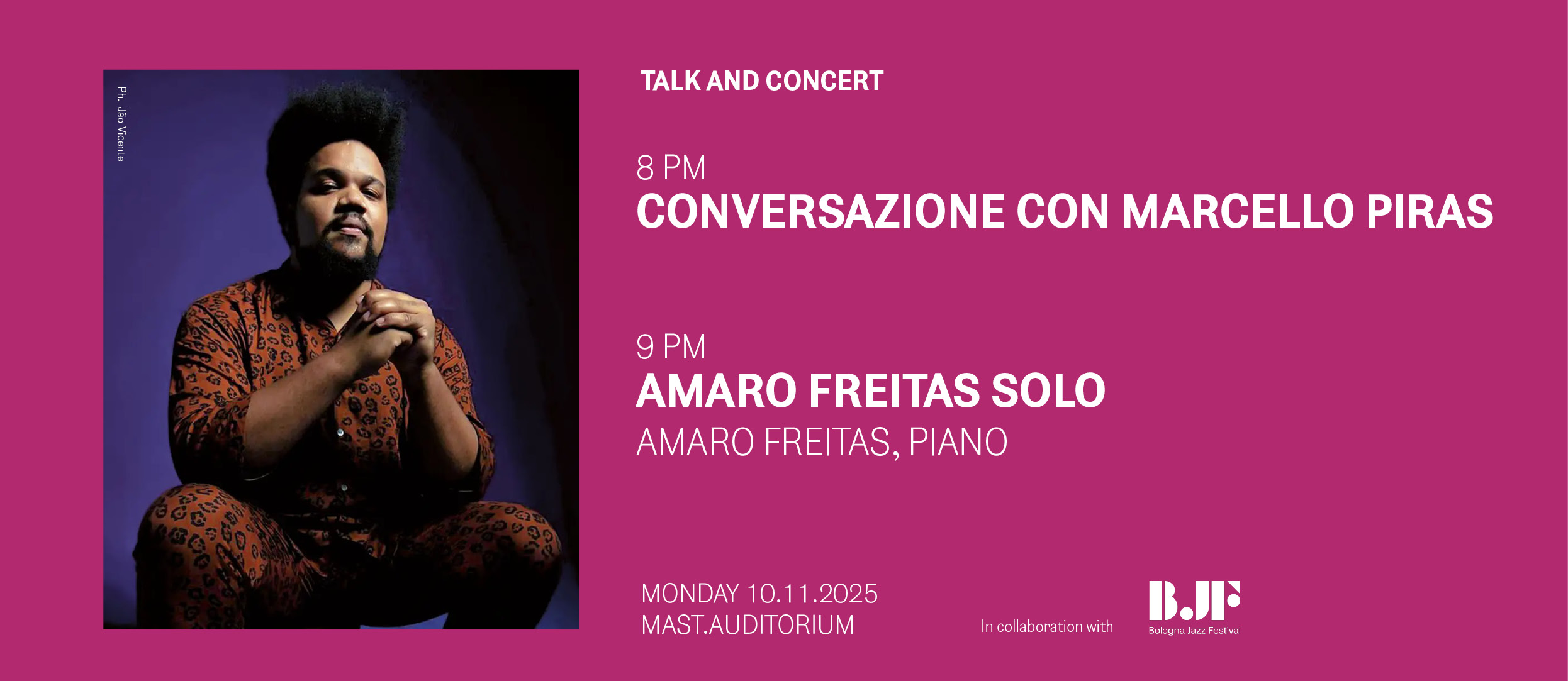
CONVERSATION WITH MARCELLO PIRAS
Musicologist Marcello Piras, internationally renowned for his research on the history of jazz and Black music, will be in conversation with Walter Rovere about the true origins of jazz.
9 PM
AMARO FREITAS SOLO
The young Brazilian pianist Amaro Freitas takes the audience on a journey through his sound universe, where jazz modernism intertwines with Brazilian folklore to produce surprising results — a kind of avant-jazz firmly rooted in Pan-African traditions.
In collaboration with Bologna Jazz Festival.
FREE ADMISSION BY RESERVATION
Book now
Marcello Piras is internationally known as a scholar of music of African descent. He has published a book on John Coltrane, another on jazz analysis, and dozens of essays in encyclopedias, books, and journals. He has lectured in Italy, Germany, Switzerland, the Netherlands, the United States, Canada, Mexico, and Brazil. He conceived and founded the Arrigo Polillo Study Center in Siena, which he directed until 1998, and he also founded and presided over SISMA (the Italian Society for the Study of African American Music). He lived in the United States, working at the Center for Black Music Research (Chicago) and teaching at Columbia College Chicago and the University of Michigan. Since 2006, he has lived in Mexico. He is about to publish a book on Scott Joplin and is currently preparing an Afrocentric history of music.
Amaro Freitas was born in Recife, on the northeastern coast of Brazil, in the harsh environment of one of its favelas. His parents faced the hardships of life in the ghetto through their faith in the Pentecostal Church. His love for music grew in this religious setting, where his attraction to percussion instruments (not well suited to Christian hymns) had to give way to the piano. In his music, Freitas channels all his passion for rhythm. A chance encounter with a video of Chick Corea ignited his imagination, inspiring him to express himself in a musical language completely foreign to the world he came from. Thus began a journey that reads like a true coming-of-age story — marked by ‘alternative’ studies, unlikely jobs, and the careful savings that made possible the self-production of his first album, Sangue Negro (2016), whose success opened the doors to a professional career. This was followed by Rasif (2018), Sankofa (2021), and Y’Y (2024), which further affirm the originality of his music.