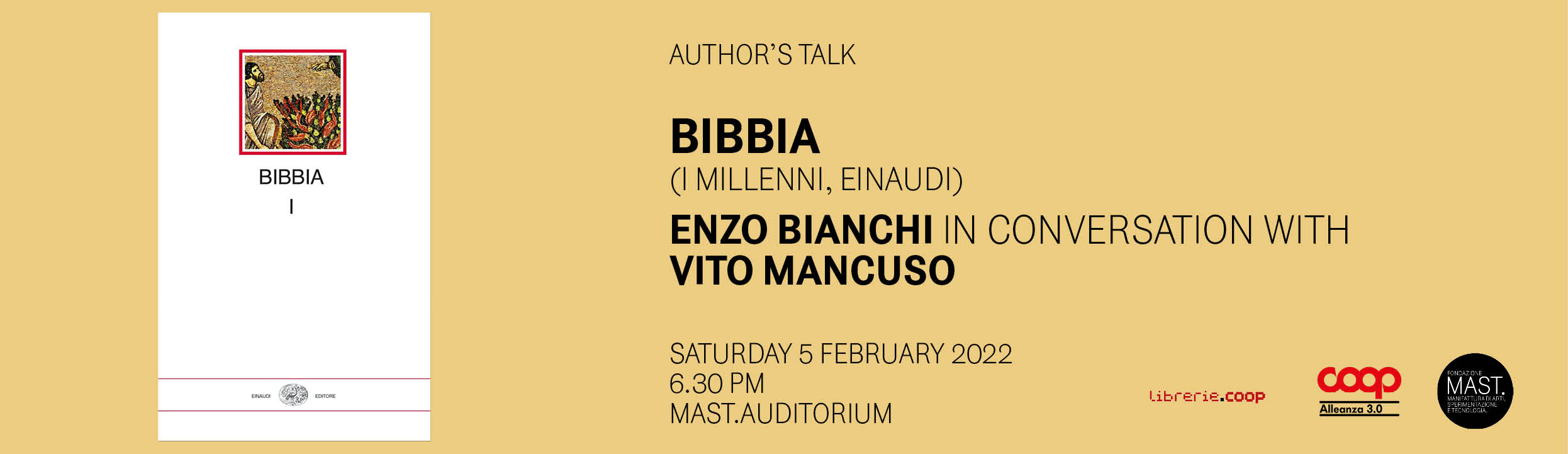
SATURDAY 5 FEBRUARY 2022
6.30 PM
MAST.AUDITORIUM
AUTHOR’S TALK
BIBBIA
(I millenni, Einaudi)
ENZO BIANCHI DIALOGA CON VITO MANCUSO
The new Einaudi edition of the Bible is distinguished by its new, non-religious translation, and is the achievement of a team of philologists and exegetes who are among the most authoritative in the world, with a profound knowledge of Hebrew, Aramaic and Greek. This translation strives to make the biblical text accessible to modern readers without homogenizing its linguistic, cultural and theological asperity.
The Bible is forever open to limitless readings, and not only for the differing interpretations, of which exist many as evidenced by the copious literature of biblical commentaries, but limitless in that it differs even depending on the reader: There are different interpretations in the Jewish faith, different interpretations in the Christian faith, and different interpretations of those who believe neither in God nor in Jesus Christ but read the Bible as “the great code,” as per the well-known expression of Northrop Frye. The great code of Western culture above all, but of others as well! For non-Jewish and non-Christian persons, the Bible does not contain “the word of God,” but remains a written testimony of human thought, expressed by attributing words and actions that have deep significance for humanity to the figure of “God”.
But do not forget that even a believer relies upon all the necessary human means for reading, interpreting and understanding the Bible. In these limitless readings, both believers and non-believers share a common path that should absolutely be emphasized and should be performed without raising suspicion. After all, churches today recognize that the Bible, though containing the word of God, is above all the word of man; that the authors are human authors, and that the Bible is a text that must be understood free of any fundamentalist interpretation. Nowadays, the Bible serves as the library that does not divide, does not separate, and does not open its doors to fundamentalism; it seeks the affirmation of diversity, of plurality and, therefore, of dialogue – because it is structurally dialogic!
Enzo Bianchi was born in Castel Boglione, in the province of Asti, in 1943. In 1965 he founded the Community of Bose, of which he served as prior until 2017. Among his very rich bibliography we point out the comments on Cantico dei Cantici, Ruth, Lamentazioni, Qohelet, Ester (Lontano da chi?, Gribaudi 1984); Genesi (Adamo, dove sei?, Qiqajon 1994); L’Apocalisse di Giovanni (Qiqajon 1999). With Einaudi he has published: La differenza cristiana (2006), Il pane di ieri (2008), Per un’etica condivisa (2009), Ogni cosa alla sua stagione (2010), L’altro siamo noi (2010), Fede e fiducia (2013), Dono e perdono (2014), Spezzare il pane (2015), Gesú e le donne (2016). For the “Millenniums” he edited the volume Regole monastiche d’Occidente (2001) and devised and edited the three volumes of the Bible (2021).
In collaboration with Coop Alleanza 3.0 and Librerie Coop