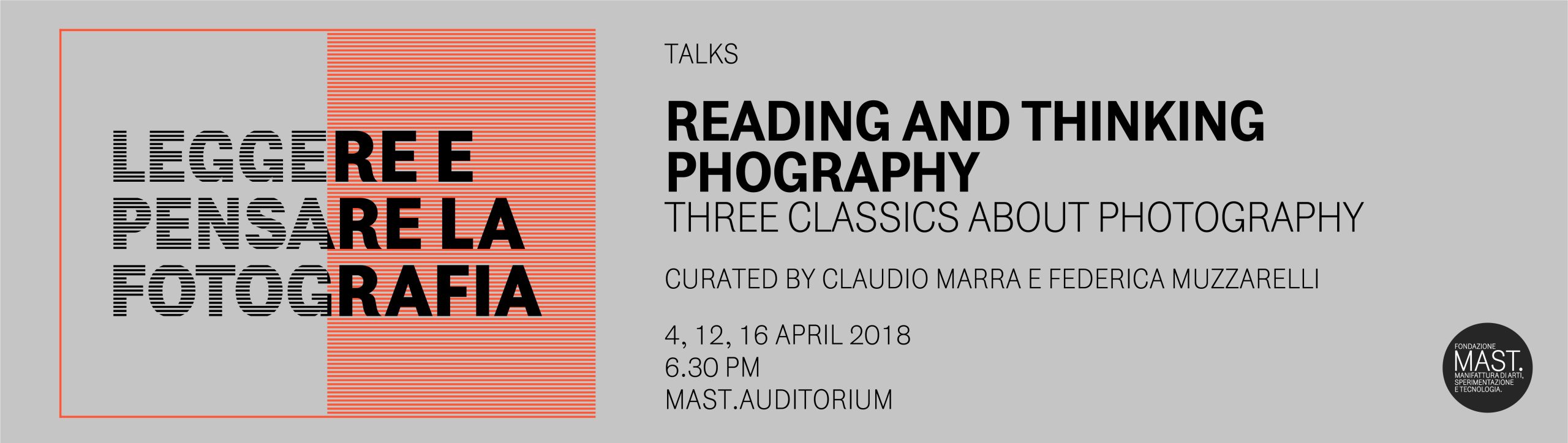
WEDNESDAY 4 APRIL 2018
6:30 PM
MAST.AUDITORIUM
CLAUDIO MARRA
ROLAND BARTHES, CAMERA LUCIDA
Roland Barthes (1915-80), one of the greatest European intellectuals of the late twentieth century, author of seminal meditations on the fields of literary criticism, semiotics, classical rhetoric, and the analysis of mass culture, with prestigious teaching positions at the Écolè des hautes Étude en Sciences Sociales and the Collège de France, is an essential reference for theoretical reflections on photography. Having written the pioneering essay The Photographic Message in 1961, he published Camera Lucida in 1980; the book, released in France and Italy at the same time, shook up the way we think about photography and reflect on its identity. Starting from an intriguing and somewhat mysterious title, so much so that it has often been misinterpreted, Barthes leads us into a sentimental side to photography, beginning with his own love for images, for those of the great photographers but also those found in family albums. The result is a fascinating and highly personal analysis which, however, succeeds at revealing the fundamental theoretical connections of a means that has now completely and permanently invaded our lives.
THURSDAY 12 APRIL 2018
6:30 PM
MAST.AUDITORIUM
FEDERICA MUZZARELLI
SUSAN SONTAG, ON PHOTOGRAPHY
In 1977 a collection of writings was published by Susan Sontag (1933-2004), the American scholar, author, and feminist activist. Those writings were translated into Italian the following year and immediately became a classic for anyone interested in or keen on photography. Perhaps the secret of the book’s success and fame lies, among other things, in its hybrid nature. In its six essays, Susan Sontag works through flashes of inspiration and continuous, fascinating references to cinema, literature, and art, fuelling them through a constant contextualisation of the vicissitudes of photography in politics, history, culture, and communication. Constructed as succession of ideas, reflections, and prompts offered with a rhapsodic progression that accompanies reader to the end of the text, On Photography engages the reader through an incredibly rich apparatus of often dazzling definitions which, while primarily grounded in America and American photography, prove themselves capable of describing photography in all its complex identity.
MONDAY 16 APRIL 2018
6:30 PM
MAST.AUDITORIUM
CLAUDIO MARRA
WALTER BENJAMIN, A SHORT HISTORY OF PHOTOGRAPHY
In 1931, Walter Benjamin (1892-1940), literary critic, author, and one of the greatest philosophers of the twentieth century, published an essay titled “A Short History of Photography” in the German magazine Literarische Welt. The late 1920s had been a remarkably lively period for German photography. In 1928 it was included as a subject taught in the Bauhaus school of design for the first time. In 1929, the great exhibition Film und Foto opened in Stuttgart, in which photography was presented in all its artistic, communicative, or applied developments. Benjamin’s text was the first attempt at finding a historical/theoretical place for a complex, many-branched cultural phenomenon that had become crucial to the characterisation of modernity. Its pages retrace the fundamental steps of the story of photography with references to technical evolution, its relationship to painting, and its socio-anthropological effects, with a sharpness of reflection that cuts through its original historical context, rendering this text essential reading even today for understanding the role that photography has taken on in our culture.
Claudio Marra is Professor of History of Photography at the University of Bologna.
Federica Muzzarelli is Associate Professor of Photography and Visual Culture at the University of Bologna, Rimini Campus.