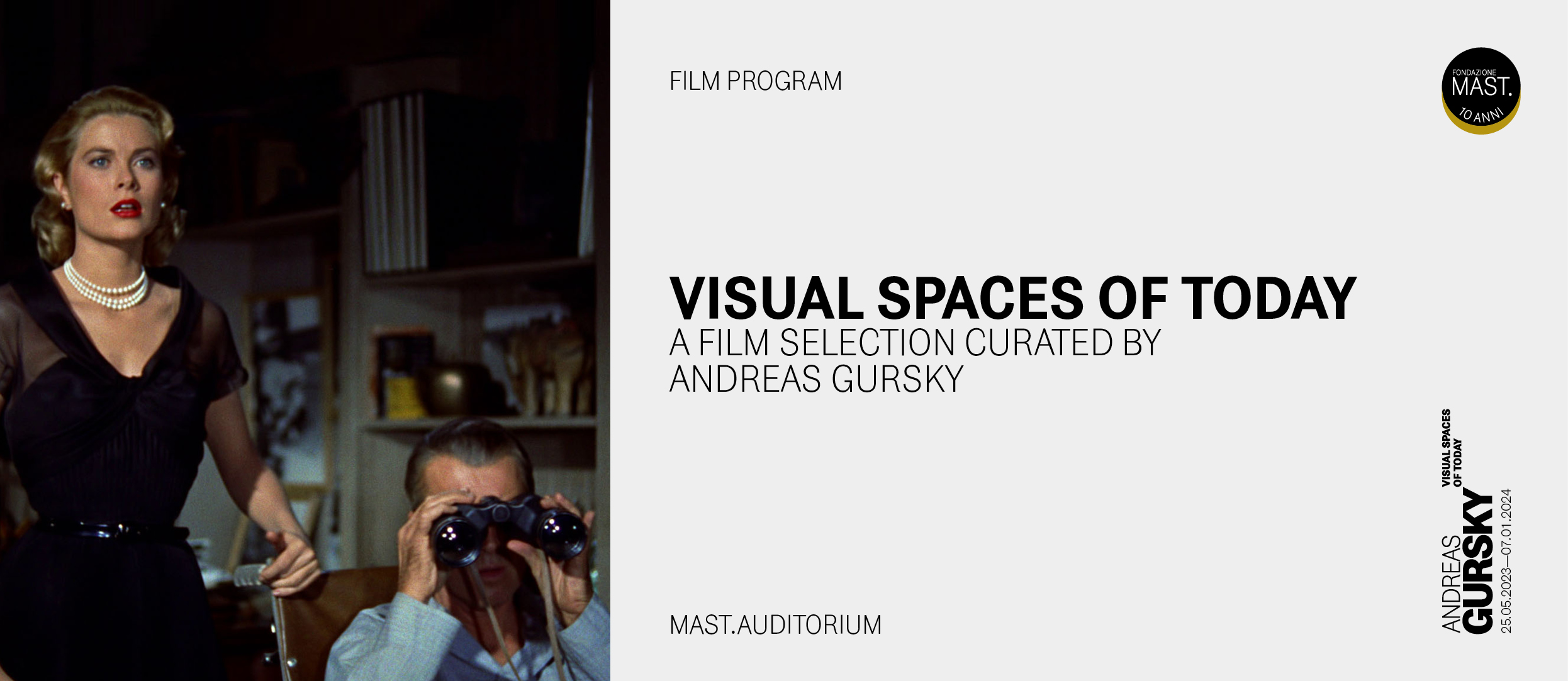
VISUAL SPACES OF TODAY
A film selection curated by Andreas Gursky
On the occasion of the exhibition Andreas Gursky. Visual Spaces of Today, cinema returns to Fondazione MAST with a first section (08.07-23.09.2023) dedicated to a selection of films that marked the photographer’s intellectual and artistic education and contributed to his visual research. Carte blanche for the titles selected by Gursky, which explore the complexity of the human condition and in particular the often-enigmatic mechanisms of vision as synthesis of the space-time relationship.
In the second section, which will begin in October, the programming will continue with a retrospective of films and documentaries that recount the world of work on the guiding themes chosen by the artist for his shots and compositions of images.
In collaboration with Cineteca di Bologna
“Films have long been part of our cultural memory. And this goes far beyond individual film quotations, but concerns our aesthetic perception in general.
I am a visual person, I think a lot in pictures. I have a large archive of press photos that I use as a source of ideas. I also love going to the cinema and have a number of favourite films that serve as inspiration for my own work. I am therefore pleased to share with you this very special selection that I have made in the context of my exhibition.
I wish you inspiring cinema evenings at the Fondazione MAST.”
Andreas Gursky
On the days of the film program, the gallery will be open until the start of the screening.
SATURDAY 8 JULY 2023
SANS SOLEIL
BY CHRIS MARKER
SUNDAY 9 JULY 2023
SOLARIS
BY ANDREJ TARKOVSKIJ
SATURDAY 15 JULY 2023
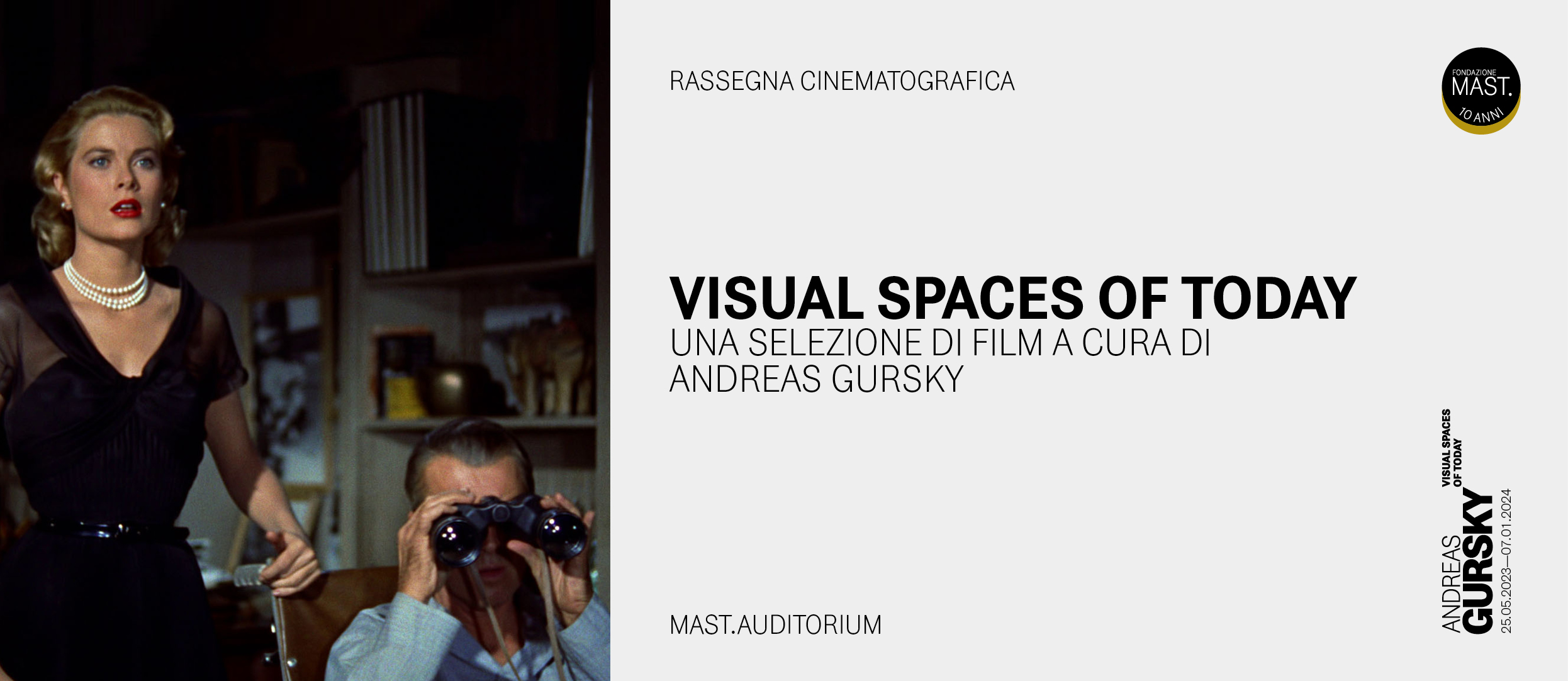
REAR WINDOW
BY ALFRED HITCHCOCK
SUNDAY 16 JULY 2023
SATANSBRATEN
BY WERNER FASSBINDER
SATURDAY 22 JULY 2023
LA GRANDE BOUFFE
BY MARCO FERRERI
SUNDAY 23 JULY 2023
LE LOCATAIRE
BY ROMAN POLANSKI
SATURDAY 9 SEPTEMBER 2023
LA CADUTA DEGLI DEI
BY LUCHINO VISCONTI
SUNDAY 10 SEPTEMBER 2023
ZABRISKIE POINT
BY MICHELANGELO ANTONIONI
SATURDAY 16 SEPTEMBER 2023
BLUE VELVET
BY DAVID LYNCH
SUNDAY 17 SEPTEMBER 2023
LE SAMOURAÏ
BY JEAN-PIERRE MELVILLE
SATURDAY 23 SEPTEMBER 2023
LE CHARME DISCRET DE LA BOURGEOISIE
BY LUIS BUÑUEL
Sans Soleil is an experimental travel diary that intertwines footage from around the world. It takes the viewer on a philosophical reflection on the nature of time and memories. It is a meditation on human memory and the inability to remember nuances, consequently portraying how the perception of personal and global stories is artificial. Today it is considered a masterpiece because it breaks the rules of documentary film-making in order to create its own unique world.
For quite some time, the three scientists aboard the scientific station orbiting the planet Solaris have been shown inexplicable behaviors., A psychologist is sent aboard to investigate what is happening and discovers that Solaris is a magmatic and living planet capable of materializing humans’ dreams and memories. This projection of people’s consciousness is the root of the astronauts’ drama. This movie is a challenging philosophical work, filled with literary and poetic allusions. It is a dramatic metaphor of anguish and desire. Awarded with the Special Jury Grand Prix at the 25th Cannes Film Festival.
Due to a fractured leg, a photojournalist forced into immobility, spends his time at the window, using a telephoto lens to spy on the behaviors of the tenants in the building across his. He becomes a detective and he is soon convinced that one of them has murdered his wife, embarking on a pursuit of the killer himself.
This comedy is among Alfred Hitchcock’s most celebrated and beloved masterpieces, and introduces “crime” into a purely domestic setting, reflecting on voyeurism not as a pathology but as a revealing element, and on cinema with its spectator function. It is an immortal piece of work that questions perception with each new viewing.
A group of intellectuals, unable to find their place in society, fall into a crisis. In order to regain their lost inspiration and creative drive, they decide to leverage the exaggeration of feelings such as moral degradation, fear of death, and corruption.
Characterized by a fast-paced rhythm, which is unusual in Fassbinder’s filmography, it adopts a farcical and excessive tone. The original title, Satansbraten, literally meaning “Satan’s roast,” carries the German connotation of “a malicious person, child of the devil, little Satan,” and alludes to the sadomasochistic relationships present among all the characters.
The movie talks about the personal history of four men (played by Marcello Mastroianni, Ugo Tognazzi, Philippe Noiret, Michel Piccoli) whom, tired of their boring and unsatisfactory life, close themselves into an apartment in Paris and engage in a grand “feast,” a gastronomic (and erotic) orgy. However, their intention is not to celebrate life and its pleasures, but rather to embrace death as a protest against life itself and the disappointments it has brought them.
A man rents a house whose owner has committed suicide by jumping out of a window. In the apartment building, the man leads a difficult life, harassed by a very strict administrator and surrounded by wired neighbors. Over time, he discovers horrific traces of the former tenant in the apartment, and gradually descends into a tunnel of madness that leads to a complete split in personality with the girl.
This movie, Polanski’s tenth and most Kafkaesque work, is a Gothic and psychological drama exploring themes of being different and exploring the state of being a stranger, thanks to its claustrophobic and grotesque atmospheres.
This film is the first one of the so-called “German trilogy” – followed by “Death in Venice” and “Ludwig”. It depicts the story of Essenbeck family, a dynasty of Rhineland industrialists their corruption, their intrigues, and final decline, against the backdrop of events immediately following Hitler’s rise to power in 1933. It portrays the downfall of an industrial bourgeoisie who, deluded into thinking they can use Nazism while maintaining their autonomy, are instead overwhelmed by it. The narrative is extremely sumptuous, lush, violent, and dark. Visconti draws inspiration from Wagnerian influences, Shakespeare’s “Macbeth,” and Thomas Mann’s “Buddenbrooks” to create a historical fresco in gloomy tones that revisits the years of Nazi ascension as a bloody Elizabethan tragedy filled with crimes, murders, and massacres of all kinds.
In Los Angeles, during a fight between the police and a group of protesters, an officer is killed. Mark is a young man believed to be responsible for the murder, who manages to escape aboard a stolen tourist plane and lands at Zabriskie Point. There, he meets a girl, a company secretary who was on her way for a vacation, and love sparks between them.
“‘Zabriskie Point’ is a beautiful movie that finds its polemical roots, based on Antonioni’s ancient theme of the difficulties of contemporary living, in its criticism of a society that is absurd and repressive in many ways (…) but it dries it up to place the story in a lyrical space where the mysterious sense of history prevails over social and political judgment, the anxiety to be reborn purged by innocence.”
(Giovanni Grazzini, ‘Corriere della Sera’, 1970)
In a quiet town in California, a young man finds a human ear in a field and takes it to the police. Together with Sandy, he begins to investigate, and soon the two discover that they must delve into the life of Dorothy Vallens, a mysterious woman who sings in a nightclub and is involved with a violent man.
This movie portrays the American province frozen in the 1950s, contains unspeakable perversions and equal innocence. “Blue Velvet” is an essay on the USA in the shape of a nightmare.
Frank Costello, also known as “the samurai,” is a hit man who, after carrying out the commissioned murder, runs away with the help of his lover. His life hangs by a thread, because he is chased by both the police and his employers, so he decides to adopt an extreme solution.
This movie is an intense and bitter meditation on fate and loneliness. Melville’s characters are anti-heroes, his pacing in the film is meticulous and deliberate, and his suspense is entirely moral. Alain Delon’s imperturbable mask serves the purpose perfectly. A masterpiece of style.
A group of six friends, the Thévenot couple, the Sénéchal couple, Miss Florence, and the South American diplomat Don Rafael, the ambassador of the Republic of Miranda, continue to arrange meetings to have lunch together. However, every time they are about to sit down at the table, some absurd unforeseen event occurs, preventing them from completing their meal.
Mockery, provocation, sharp anti-bourgeois and anti-Catholic satire, indecisiveness between reality and dream: these are some of the characteristics of Buñuel’s cinema – an heir to Surrealism, of which he was one of the initiators in the film industry. This is where also find in this film.
Winner of the Academy Award for Best Foreign Language Film in 1973.