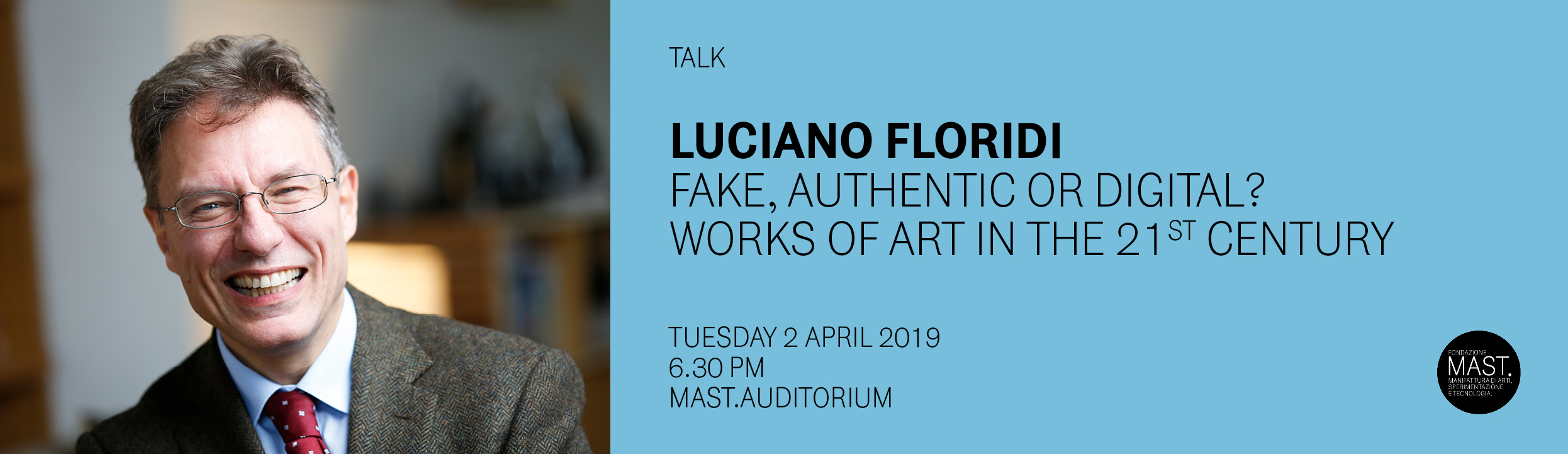
TUESDAY 2 APRIL, 2019
6.30 PM
MAST.AUDITORIUM
TALK
LUCIANO FLORIDI
FAKE, AUTHENTIC OR DIGITAL?
WORKS OF ART IN THE 21ST CENTURY
The art world is flooded with replicas. Some are honest reproductions. Others are fakes. The difference is based on the idea of authenticity, but today digital technology is redefining this fundamental notion. Digital tools allow us to discover but also to create fakes (the so-called “deepfakes”) and are giving way to a new, hybrid form of artworks which I recently defined as “authentic but not orginal”. Microsoft, for instance, in collaboration with the Rembrandt House Amsterdam, thanks to AI techniques has created a gentleman’s portrait which is and, at the same time, is not a Rembrandt. A new “Rembrandt” work, which Rembrandt himself never painted; a new creation challenging the banal notion of “authenticity”. Luciano Floridi will discuss these new phenomena and the way they can be effectively interpreted and managed.
Luciano Floridi is Professor of Philosophy and Ethics of Information at the University of Oxford, where he directs the Digital Ethics Lab of the Oxford Internet Institute, and is Professorial Fellow of Exeter College. He is also Turing Fellow and Chair of the Data Ethics Group of the Alan Turing Institute. His areas of expertise include digital ethics, the philosophy of information, and the philosophy of technology. Among his recent books, all published by Oxford University Press (OUP): The Fourth Revolution – How the infosphere is reshaping human reality (2014), winner of the J. Ong Award; The Ethics of Information (2013); The Philosophy of Information (2011). His most recent book, The Logic of Information, has just been published.