
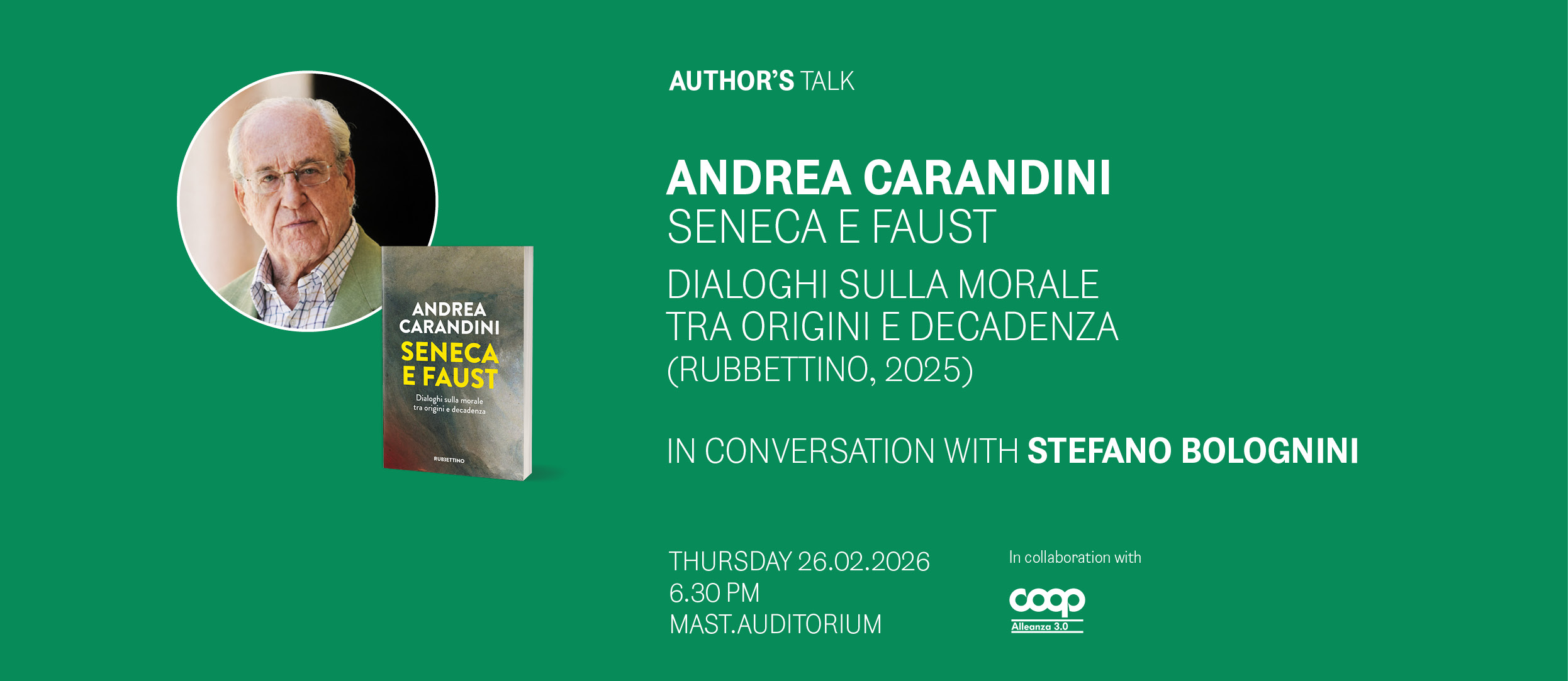
In an imaginary dialogue between Seneca, a wise man of antiquity, and Faust, a symbol of modernity, Andrea Carandini traces an archaeology and futurology of moral consciousness. In this philosophical journey between past and future, the author denounces the collapse of humanistic culture and invites us to rediscover an ancient and universal wisdom capable of sustaining new hope for humanity in the 21st century.
The author in conversation with Stefano Bolognini, psychiatrist and psychoanalyst.
As part of the review Le Voci dei Libri, in collaboration with Coop Alleanza 3.0
FREE ADMISSION BY RESERVATION
Book now
Andrea Carandini, professor emeritus of Archaeology and History of Greek and Roman Art at Sapienza University of Rome, a student of Ranuccio Bianchi Bandinelli, conducted important excavations between the Palatine Hill and the Forum, discovering early Rome in the 8th century and Rome before Rome in the 9th century BC. From 2009 to 2012, he was president of the Higher Council for Cultural Heritage and from 2013 to 2021 president of the FAI. Author of numerous books, he edited The Atlas of Ancient Rome (2017) for Princeton University Press and La leggenda di Roma (2006-2014) for Mondadori. For Rubbettino, he edited Paesaggio di idee. Tre anni con Isaiah Berlin (2015) and Seneca e Faust. Dialoghi sulla morale tra origini e decadenza.
Stefano Bolognini, psychiatrist and psychoanalyst, is president of the Italian Psychoanalytic Society and member of the European editorial board of the International Journal of Psychoanalysis. For years he has been actively involved in scientific and institutional activities within the International Psychoanalytic Association, with articles, seminars, and conferences in Europe, Latin America, and North America. For Bollati Boringhieri, he has published, as editor, Il sogno cento anni dopo and, as author, L’empatia psicoanalitica and Passaggi segreti. Teoria e tecnica della relazione interpsichica (2008), which have been translated and published in various languages. His collection of short stories Come vento, come onda (1999) won the Gradiva Prize.